
A Year in Review, Without All the Answers

Before making resolutions for another year, consider twoquestions you can answer today—even if you don’t know what comes next.
By Tim Preston and Jonathan Thomas
Summary
As another year draws to a close, we’re encouraged to reflect on our accomplishments, evaluate our progress, and plan what comes next. But our lives rarely fit neatly into an annual review. Success and struggle, gratitude and disappointment, certainty and uncertainty can coexist. Perhaps the most useful place to begin isn’t with another resolution, but with a clearer understanding of where we are and where we’d like to be.
Another year is ending, and with it comes a familiar invitation to look back, measure our progress, and prepare for what lies ahead. We review our finances, careers, relationships, health, and accomplishments, often with an unspoken expectation that we should have something to show for the past twelve months.
But a human life is not a quarterly earnings report.
Someone can have an extraordinary professional year and a difficult personal one. A relationship can improve while physical energy declines. We can feel confident in one part of our lives and uncertain in another. Gratitude and disappointment can coexist without canceling each other.
Meanwhile, the world continues competing for our attention. Political change, artificial intelligence, economic uncertainty, family responsibilities, and everyday demands rarely leave much room for reflection.
The world has plenty of opinions about where we’re going. How often do we give ourselves an opportunity to notice where we are?
The Year We Remember
When we look back over a year, certain moments stand out: a promotion, an unexpected loss, a difficult conversation, an accomplishment that once seemed impossible. Other experiences fade into the background.
Psychologist Daniel Kahneman distinguished between the experiencing self, which lives through moments, and the remembering self, which constructs the stories we tell about those experiences. The year we remember isn’t necessarily the entirety of the year we lived.
Our interpretations matter, too. In The Fifth Discipline, Peter Senge explored how mental models—our assumptions about ourselves and the world—influence what we notice and how we act. The expectations we carried into January may no longer describe our circumstances today. Something may have changed around us, within us, or in how we understand what happened.
Rather than deciding what the year meant, perhaps we can begin by recognizing where we are now.
What Success Doesn’t Always Reveal
Consider an accomplished attorney reflecting on a particular situation in his life. When asked where he was on a scale of 1–10 and where he wanted to be, he initially answered intellectually: he was at a 6 and wanted to reach a 9.
But when the question shifted from what he thought to how he felt, his response changed. Emotionally, he was closer to a 2 and would welcome reaching a 5. He recognized that he’d been beating himself up.
His professional competence hadn’t disappeared. The two perspectives simply revealed different information about his experience.
Now imagine a 17-year-old approaching graduation. School is going well, friendships matter, and possibilities are opening up. Yet questions about college, careers, finances, and the future seem to arrive faster than answers.
Adults ask, often with the best intentions, “What are you going to do next?”
It’s a reasonable question, but what if the student doesn’t know?
Instead of asking for a five-year plan, we might begin with something smaller: When you think about life after graduation, where is your emotional energy today?
Perhaps the student identifies a 4 and would like to reach a 6. No career has been chosen, and no life purpose has been discovered. Yet the student has identified something useful: a current position and a preferred direction.
These two situations, separated by age and experience, remind us that accomplishments and circumstances don’t necessarily reveal how someone is experiencing life.
Two Questions, One Situation at a Time
As another year approaches, consider giving yourself a few minutes—not to evaluate your entire life, but to choose one specific situation that matters to you. It might involve a relationship, your professional life, your physical well-being, or an expectation you’ve been carrying.
Using the emotional energy scale below, consider two questions:
1. Where am I now?
2. Where would I like to be?
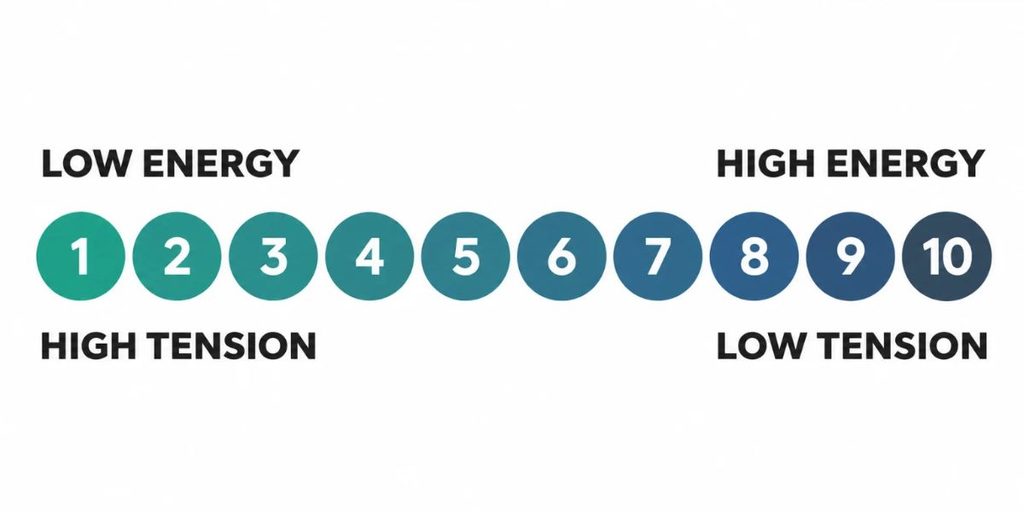
You might be at a 3 and prefer a 5, or at an 8 and be content where you are. There is no right or wrong position. You don’t need to explain either number or know how to move between them.
The numbers are personal reference points, not grades or clinical measurements. They provide information about your experience and a direction you might prefer.
Emotions can be data without being directives. Positions can provide direction without
becoming instructions.
If you’d like, choose another situation. You may discover that you’re in very different places across different parts of your life. That’s not inconsistency; it’s information.
What becomes possible when we notice the distance between where we are and where we’d like to be?
Behavioral economist George Loewenstein’s research on curiosity explored how recognizing a gap between what we know and what we want to know can motivate inquiry. Our current and preferred emotional positions aren’t the same as an information gap, but the comparison may invite curiosity.
What matters most in this situation? What might I not be seeing? Who else is involved? What resources are available? Is there a Best Next Step worth considering?
We don’t need to answer every question. The space between two positions isn’t necessarily a problem to solve. It can be an opportunity for learning, appreciation, connection, or simply noticing something we hadn’t recognized before.
As the year ends, there will be plenty of invitations to set goals, improve habits, and make resolutions. Those practices have their place. But perhaps we can begin somewhere else: recognizing the relationships that matter, the experiences that shaped us, what we’re grateful for, and what we’re still learning.
We may identify a direction without knowing how to get there. We may discover a conversation worth having or a question worth exploring. Or we may simply notice.
We don’t have to know what our lives mean to recognize something meaningful about where we are.
Another year doesn’t have to begin with another resolution. It can begin with orientation.
Frequently Asked Questions
About the Authors
Tim Preston is co-founder of Simple. Not Easy., co‑creator of CoreSelf Framework, and co‑author of CoreSelf Positioning (2025). A former architect, entrepreneur, and business leader, he explores how individuals, teams, and organizations regain clarity, agency, and direction amid complexity and uncertainty.
Jonathan Thomas, MSW is a Bowen Family Systems practitioner, educator, co-creator of CoreSelf Framework, and co-author of CoreSelf Positioning (2025). Across five decades of work with children, parents, and families, he explored how people develop awareness, navigate relationships, and orient themselves during periods of challenge, change, and uncertainty.
Learn more about Jonathan, Tim & CoreSelf Positioning.