
The Paradox of Optimization – Part 1
Why Organizations Over-Invest in Visibility While Under-Investing in Orientation
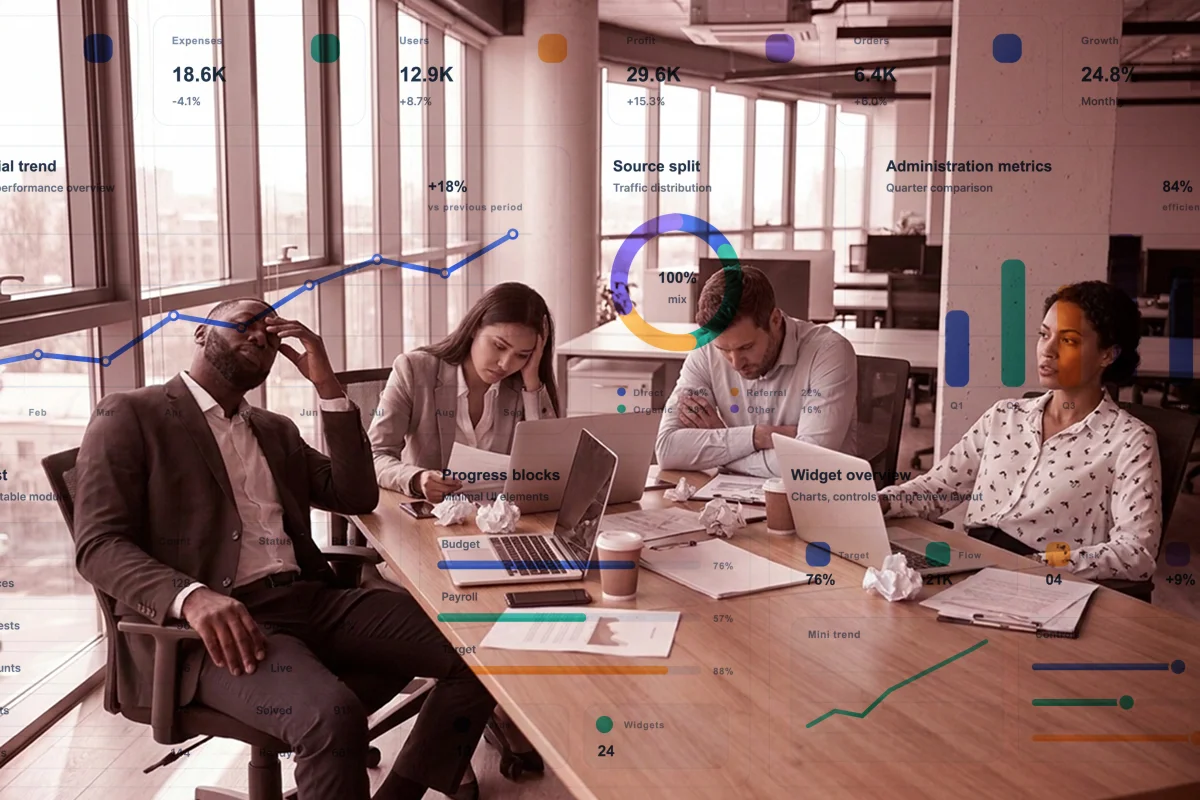
Claire stared at the dashboard for a few seconds longer than usual.
Sales activity was up.
CRM touches were up.
Customer outreach was up.
Internal responsiveness was up.
And yet revenue continued drifting downward.
The executive team sat quietly while the numbers glowed confidently across the screen.
“We’re doing more,” Claire finally said, adjusting her glasses, “but somehow getting less.”
No one disagreed.
Not Marcus from People Operations.
Not Elena, the regional manager caught between executive pressure and team burnout.
Not Hunter from Compliance.
Not David, the board representative asking increasingly direct questions about margin pressure and accountability.
Even Maya — one of the company’s strongest performers — had grown unusually quiet in recent meetings.
Six months earlier, leadership had implemented a series of optimization initiatives:
• tighter KPI visibility,
• response-time expectations,
• activity dashboards,
• meeting accountability,
• pipeline reporting,
• workflow tracking,
• and productivity analytics.
None of it seemed unreasonable individually.
In fact, much of it made sense.
The company had grown quickly.
Visibility had become harder.
Leaders needed clarity.
Managers needed consistency.
Shareholders wanted predictability.
But something subtle had changed.
Employees had slowly become more visible…
while simultaneously becoming harder to see.
A few weeks later, Elena discovered one of her employees using a mouse jiggler.
At first, she was frustrated.
Then she was confused.
The employee wasn’t underperforming.
In fact, he consistently exceeded expectations.
Which raised an uncomfortable question:
If productive employees feel pressure to simulate visibility… what exactly are organizations measuring?
This is the paradox many modern organizations quietly face.
As pressure rises, companies often increase optimization:
• more dashboards,
• more analytics,
• more monitoring,
• more process,
• more visibility.
But optimization without orientation creates unintended consequences.
When organizations over-invest in visibility systems while under-investing in orientation systems, employees often respond with performative visibility rather than meaningful engagement.
Not always maliciously.
Not always consciously.
But predictably.
Marcus believed the company’s problem wasn’t accountability.
It was orientation.
People could explain:
• their metrics,
• their tasks,
• their deadlines,
• their workflows.
But fewer could clearly answer:
• Where are we?
• Where are we trying to go?
• What matters most right now?
• What pressures are shaping our behavior?
• What are we optimizing for?
• What happens when those priorities conflict?
The organization had become operationally sophisticated…
while slowly becoming relationally disoriented.
Meanwhile, David viewed the situation differently.
As a board member, he had fiduciary obligations.
Markets didn’t reward ambiguity.
Forecast misses had consequences.
Stories about culture did not replace financial discipline.
And to him, dashboards weren’t oppression.
They were risk management.
“If we can’t see it,” he said during one meeting, “we can’t manage it.”
Claire nodded immediately.
Marcus didn’t.
Because he believed something equally true:
Organizations often want visibility before trust exists.
But humans usually require trust before honest visibility emerges.
That tension may define the modern workplace more than most leaders realize.
Many organizations are simultaneously experiencing:
1. an internal orientation challenge,
2. and an external trust challenge.
Employees increasingly struggle with:
• clarity,
• meaning,
• energy,
• direction,
• and sustainable rhythms.
Organizations increasingly struggle with:
• trust,
• alignment,
• visibility,
• accountability,
• and performance under pressure.
So both sides compensate.
Employees often compensate through:
• disengagement,
• performative activity,
• emotional withdrawal,
• or circumvention.
Organizations often compensate through:
• increased measurement,
• tighter controls,
• optimization systems,
• and surveillance-adjacent visibility tools.
The result is a growing cycle of mutual uncertainty.
Elena understood both sides.
That was the hardest part.
Her team wanted autonomy.
Leadership wanted predictability.
Compliance wanted documentation.
Finance wanted clarity.
Customers wanted responsiveness.
And she wanted everyone to stop performing work long enough to actually improve it.
One afternoon, after another meeting about productivity metrics, Maya stayed behind.
Quietly, she said something Elena hadn’t been able to stop thinking about since.
“I don’t think people mind accountability,” Maya said.
“I think they mind feeling like they’re constantly proving they exist.”
The room stayed quiet for a moment.
Because everyone knew exactly what she meant.
A month later, the company redesigned its onboarding process.
Inside each welcome package:
• laptop,
• hoodie,
• notebook,
• coffee mug,
• and a company-branded mouse jiggler.
The note attached read:
“This doesn’t work.
Neither do cultures built on suspicion.If you ever wonder whether we trust you, look at this useless mouse jiggler.
We hired you for judgment, not cursor movement.”
The point wasn’t the gadget.
It was the signal.
Modern organizations are flooded with optimization systems.
Far fewer invest in orientation systems:
systems that help individuals and teams understand:
• where they are,
• where they want to go,
• what matters most,
•and how to move together without performative visibility replacing meaningful engagement.
Because sustainable optimization does not begin with visibility.
It begins with orientation.
Read Part 2, Orientation Before Optimization.
Frequently Asked Questions
About the Authors
Tim Preston is co-founder of Simple. Not Easy., co‑creator of CoreSelf Framework, and co‑author of CoreSelf Positioning (2025). A former architect, entrepreneur, and business leader, he explores how individuals, teams, and organizations regain clarity, agency, and direction amid complexity and uncertainty.
Jonathan Thomas, MSW is a Bowen Family Systems practitioner, educator, co-creator of CoreSelf Framework, and co-author of CoreSelf Positioning (2025). Across five decades of work with children, parents, and families, he explored how people develop awareness, navigate relationships, and orient themselves during periods of challenge, change, and uncertainty.
Learn more about Jonathan, Tim & CoreSelf Positioning.