
Change Doesn’t Begin with Pain. It Begins with Possibility.
We’ve all heard some version of the advice:
The benefits of change far outweigh the pain of change.
It’s a comforting idea.
The problem is that it rarely works.
If it did, more people would exercise regularly, save for retirement, have difficult conversations,
leave unhealthy relationships, start businesses, learn new skills, and pursue meaningful goals.
Most of us already know the benefits.
Knowledge is rarely the issue.
The challenge is that human beings are naturally loss averse. We tend to fear losing what we have more than we value what we might gain. Even when our current situation is frustrating, limiting, or painful, it has one advantage:
It’s familiar.
The known feels safer than the unknown.
Which is why another popular observation often feels more accurate:
People change when the pain of staying the same becomes greater than the pain of change.
There is truth in that.
But it is still incomplete.
Because some of life’s most meaningful changes don’t begin with pain at all.
An entrepreneur doesn’t start a company because the pain of employment suddenly becomes unbearable.
A parent doesn’t welcome a child into the world because the alternative became intolerable.
A student doesn’t pursue a difficult path because comfort became impossible.
In each case, something else appears first.A possibility.
Often not a certainty.
Not a guarantee.
Not even a plan.
Just a glimpse.A glimmer.
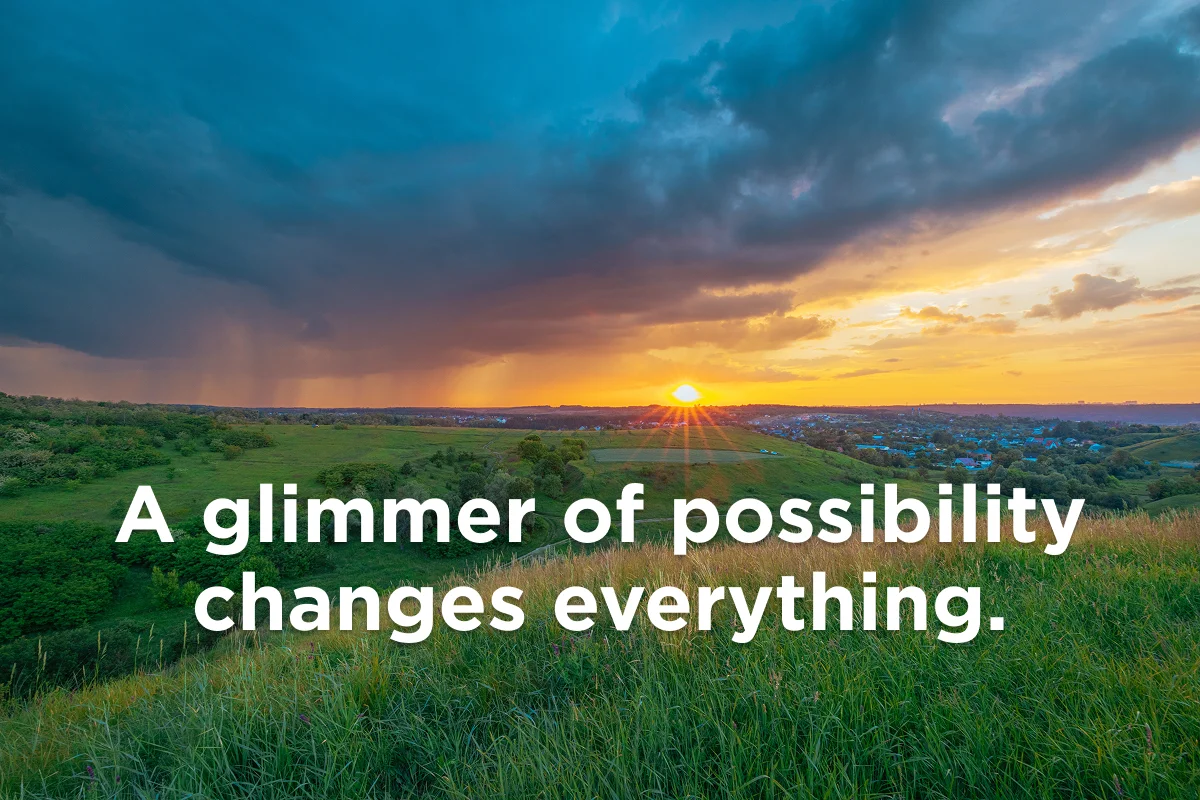
And that glimmer changes everything.
The future is no longer an empty unknown. It becomes a possibility worth exploring.
The entrepreneur sees a company that doesn’t yet exist.
The parent imagines a family that does not yet exist.
The student sees a future self they would like to grow into.
None of them know exactly how things will unfold.
But the possibility becomes more compelling than the certainty of where they are.
Perhaps that is how meaningful change actually begins.
Not when the pain becomes unbearable.
Not when the benefits become obvious.
But when possibility becomes visible.
Because possibility does something pain cannot.
Possibility awakens curiosity.
And curiosity changes our relationship with uncertainty.
Instead of asking:
“What if this goes wrong?”
We begin asking:
“What if this works?”
“What might I learn?”
“What becomes possible if I take the next step?”
The uncertainty remains.
The risk remains.
The difficulty remains.
But our attention shifts.
And once curiosity appears, experimentation follows.
Once experimentation begins, learning follows.
And once learning begins, change is already underway.
Perhaps that is why some of the most transformative moments in life begin with something surprisingly small.
Not certainty.
Not confidence.
Not motivation.
A glimmer of possibility.
A simple thought that says:
“What if?”
And from that moment forward, the future is no longer something to fear.
It becomes something to explore.
Change begins when possibility becomes more compelling than certainty.
Curiosity may be the bridge between certainty and change.
What possibility are you curious enough to explore?
Frequently Asked Questions
References
Loewenstein, George (1994). The Psychology of Curiosity: A Review and Reinterpretation.
A foundational paper proposing that curiosity emerges when we recognize a gap between what we know and what we want to know. Rather than treating curiosity as a personality trait, Loewenstein frames it as a natural response to uncertainty and incomplete information.Clark, M.H. (2020).This Is Permission.
A short, beautifully illustrated reminder that growth often begins when we give ourselves permission to explore what feels uncertain, uncomfortable, or unfinished.
Shaich, Ron (2023). Know What Matters: Lessons from a Lifetime of Transformations.
Reflections from the founder of Panera Bread on reinvention, personal transformation, and the importance of pursuing possibilities that align with what matters most.Katan, Tania (2024).The Perception Box.
Explores how our experiences, assumptions, beliefs, and cultural conditioning shape the invisible box through which we view ourselves and the world. Curiosity can help us recognize and expand the boundaries of that box.
Mackesy, Charlie (2025).Always Remember: The Boy, the Mole, the Fox, the Horse, and the Storm.
A reflection on courage, uncertainty, resilience, and continuing forward when the path ahead is unclear. The story reminds us that meaningful movement often begins before certainty arrives.
About the Authors
Tim Preston is co-founder of Simple. Not Easy., co‑creator of CoreSelf Framework, and co‑author of CoreSelf Positioning (2025). A former architect, entrepreneur, and business leader, he explores how individuals, teams, and organizations regain clarity, agency, and direction amid complexity and uncertainty.
Jonathan Thomas, MSW is a Bowen Family Systems practitioner, educator, co-creator of CoreSelf Framework, and co-author of CoreSelf Positioning (2025). Across five decades of work with children, parents, and families, he explored how people develop awareness, navigate relationships, and orient themselves during periods of challenge, change, and uncertainty.
Learn more about Jonathan, Tim & CoreSelf Positioning.